Call for Applications: AICAP Winter School on the Epigraphy of AlUla
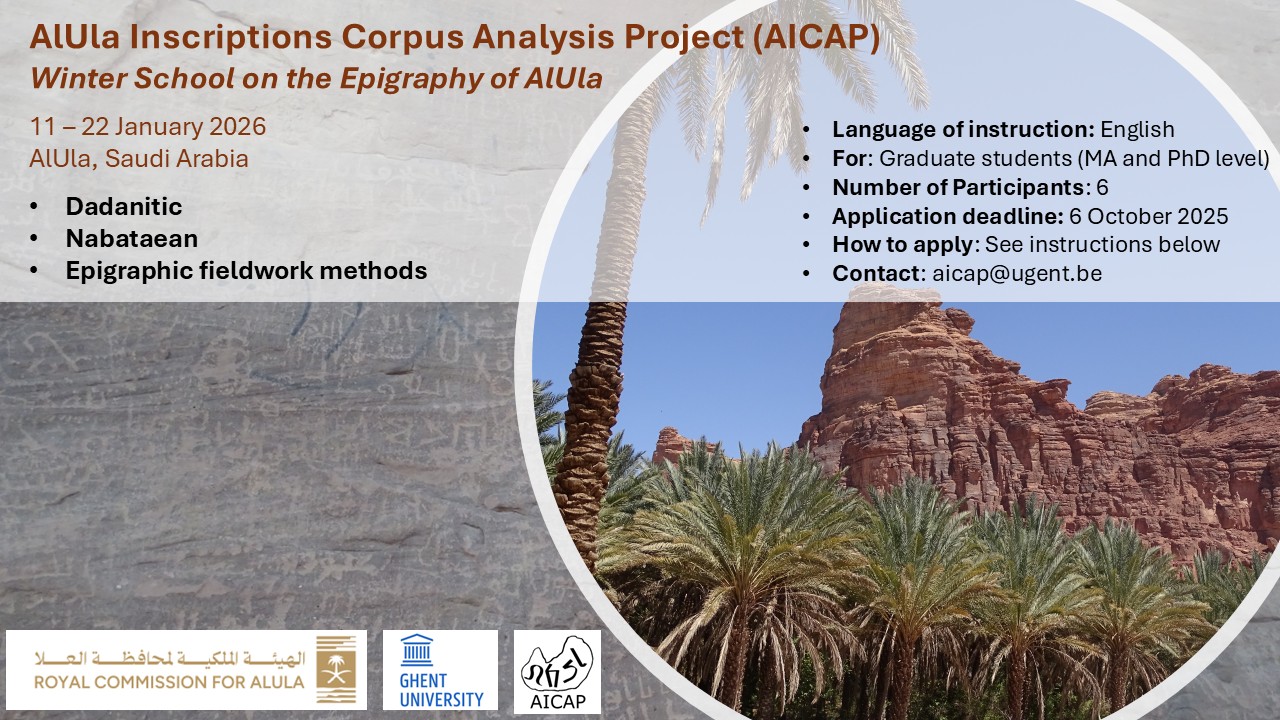
Dates: 11 – 22 January 2026
Location: AlUla, Saudi Arabia
Language of instruction: all courses will be taught in English
Courses: Fieldwork methods; Dadanitic; Nabataean
Instructors: Jérôme Norris (epigraphic fieldwork methods); Fokelien Kootstra-Ford (Dadanitic); Benjamin Suchard (Nabataean)
The AICAP project (AlUla Inscriptions Corpus Analysis Project) is pleased to announce a two-week Winter School designed for graduate-level students with an interest in epigraphy, ancient languages, digital humanities, archaeology, and the cultural heritage of Northwest Arabia.
The AlUla region is home to a wealth of documentary heritage written on stone throughout many centuries. Between 2018 and 2020, the Royal Commission for AlUla’s IDIHA project documented over 20.000 inscriptions in the region, written in many different scripts, ranging from the pre-Islamic era, including various types of Aramaic scripts, Ancient South Arabian, and variants of the Ancient North Arabian scripts, up to Early Islamic Arabic and Modern Arabic inscriptions. AICAP is dedicated to analyzing the epigraphic material that they collected and to build an online searchable database to facilitate research on AlUla’s epigraphic heritage.
AICAP is hosting this winter school to offer hands on training to work with AlUla’s epigraphic material. Over the course of two weeks, students will be introduced to Dadanitic, Nabataean and epigraphic fieldwork methods. This unique practical approach will allow students to immediately put the skills they are learning into practice to obtain experience with all aspects of epigraphic work, from collecting material in the field, to processing the GPS data and qualitative notes they took in the field, to reading inscriptions and writing up an edition of a short inscription.
Program and logistics:
The course will consist of two weeks (ten days, Sunday to Thursday) of full-time classes, with a weekend in between. The courses will be organized into three blocks of at least two hours each day, with the possible addition of two extra hours for field trips (8–10 a.m./10 a.m.–12 p.m., 2–6 p.m.).
Students will have to arrange their own travel to AlUla. If you are travelling from outside Saudi Arabia, please be aware that you will need a visa to enter the country. Unfortunately, AICAP cannot offer funding for this.
In AlUla, we will make sure that there will be transportation from the airport to your accommodation.
In AlUla, we can offer you housing and meals. At the accommodation, both men and women will stay in the same house. To ensure privacy, men’s and women’s bedrooms and bathrooms will be in different areas of the accommodation.
Max number of participants: 6
Who should apply: Graduate students (MA and PhD level) in relevant fields such as archaeology, ancient history, epigraphy, Semitic studies, digital humanities, and GIS. Knowledge of at least one Semitic language (such as Arabic) is a requirement. A background in the history of the region, philology, archaeology or epigraphy is helpful but not required.
How to apply: Please send an email with:
– Your CV
– A letter of motivation
To Areen Sweetat: aicap@ugent.be
Application deadline: 6 October 2025
Please contact Areen Sweetat with any questions about the application: aicap@ugent.be
For more information about AICAP, please visit:
https://research.flw.ugent.be/en/projects/aicap-alula-inscriptions-corpus-analysis-project.
Find us on social media:
• on X: @AicapUgent
• on Instagram: @aicap2025
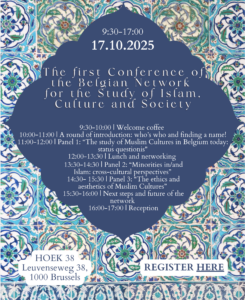 Academics from the different Belgian universities have gathered to set up a Belgian network for the study of Islam, Culture and Society.