Call for applications: AICAP Winter School on the Epigraphy of AlUla
The AlUla Inscriptions Corpus Analysis Project (AICAP) is pleased to announce a one-week Winter School designed for Saudi graduate-level students with an interest in epigraphy, ancient languages, digital humanities, archaeology, and the cultural heritage of the Arabian Peninsula.
The AlUla region is home to a wealth of documentary heritage written on stone throughout many centuries. Between 2018 and 2021, the Royal Commission for AlUla’s IDIHA project documented over 20.000 inscriptions in the region, written in many different scripts, ranging from the pre-Islamic era, including various types of Aramaic scripts, Ancient South Arabian, and variants of the Ancient North Arabian scripts, up to Early Islamic Arabic and Modern Arabic inscriptions. AICAP is dedicated to analyzing the epigraphic material that they collected and to build an online searchable database to facilitate research on AlUla’s epigraphic heritage.
AICAP is hosting this winter school to offer hands-on training to work with AlUla’s epigraphic material. Over the course of five days, students will be introduced to Dadanitic, Nabataean and epigraphic fieldwork methods. This unique practical approach will allow students to immediately put the skills they are learning into practice to obtain experience with all aspects of epigraphic work, from collecting material in the field, to processing the GPS data and qualitative notes they took in the field, to reading inscriptions and writing up an edition of a short inscription.

Program and logistics:
The course will consist of two parts, the first three classes will be taught online. These will include an introduction to Nabataean (Sunday 29 November 2026), an introduction to Dadanitic (Monday 30 November 2026), and an introduction to epigraphic methods (1 December 2026). During the following weekend (Friday-Saturday 4-5 December), students will come to AlUla, where they will spend one day in the field to collect data, and one day processing the data they collected, bringing together all the skills they learned during the online classes and the field day.
Students will have to arrange their own travel to AlUla. Unfortunately, AICAP cannot offer funding for this. In AlUla, we will make sure that there will be transportation from the airport to your accommodation.
In AlUla, we can offer you housing and meals. At the accommodation, both men and women will stay in the same house. To ensure privacy, men’s and women’s bedrooms and bathrooms will be in different areas of the accommodation.
Who we are?
The AlUla Inscriptions Corpus Analysis Project (AICAP) is a four-year collaboration between Ghent University and the Royal Commission for AlUla (RCU), which runs until May 2028. The project will develop an online, accessible, long-term database of the inscriptions documented in the AlUla County, in Saudi Arabia, by the RCU. The inscriptions include texts from as early as the 6th century BC up to modern Arabic graffiti.
Max number of participants: 6
Who should apply: Saudi Graduate students (MA and PhD level) in relevant fields such as archaeology, ancient history, epigraphy, Semitic studies, digital humanities, and GIS. Working knowledge of English is a requirement. A background in the history of the region, philology, archaeology or epigraphy is helpful but not required.
How to apply:
Please send an email with the following information to: Areen Sweetat aicap@ugent.be
- Your CV
- A letter of motivation
Application deadline: Saturday 16 October 2026
Please contact Areen Sweetat with any questions about the application: aicap@ugent.be
For more on the project and team members see:
https://research.flw.ugent.be/en/projects/aicap-alula-inscriptions-corpus-analysis-project
Find us on social media:
- on X: @AicapUgent
- on Instagram: @aicap2025


 We have three open research positions within the
 Conference dates: 11-13 April 2027

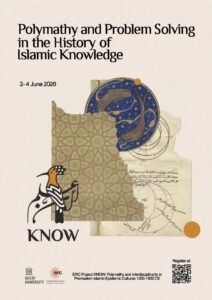 ERC KNOW International Workshop: Polymathy and Problem-Solving in the History of Islamic Knowledge, 2-4 June 2026, Ghent University