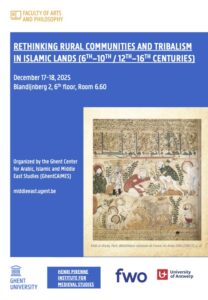
Rethinking Rural Communities and Tribalism in Islamic Lands (6th –10th / 12th –16th Centuries) (17-18/12/25)


Organising committee: Prof. Jo Van Steenbergen (Ghent University), Prof. Malika Dekkiche (Antwerp University), Dr. Zacharie Mochtari de Pierrepont (Ghent University)

Venue: Ghent University, Blandijnberg 2, 6th floor, room 6.60

Date: 17 and 18 December 2025


Rethinking Rural Communities and Tribalism in Islamic Lands (6th –10th / 12th –16th Centuries)

Rural communities and tribal formations have long been integral to the social and economic fabric of the premodern Islamic world. Yet, despite their significance, the complexities of their histories and internal dynamics have received comparatively limited scholarly attention relative to urban settings. The workshop, Rethinking Rural Communities and Tribalism in Islamic Lands (6th-9th/12th-15th centuries) seeks to address this imbalance by critically examining not only the lived realities, adaptive strategies, and agency of rural populations and tribal groups within Islamic societies, but also the ways in which their histories have been written, represented, and conceptualized.

Recent academic studies have highlighted the village as a focal point for identity construction and collective memory, as well as the entangled relationships that developed among rural populations, their elites, and governing authorities. Tribalism, frequently characterized as a static or divisive phenomenon, is instead approached here as a dynamic and persistent social phenomenon that deserves to be better understood and analyzed. In the context of the premodern Islamic world, tribal affiliations have shaped systems of authority, economic interaction, and social cohesion from the early Islamic period through the medieval era and beyond. Rather than representing vestiges of a bygone era, both tribes and rural communities have demonstrated considerable adaptability in response to shifting political and economic conditions, negotiating degrees of autonomy, resisting various forms of exploitation, and functioning as essential intermediaries between state power and local society.

This workshop seeks to foster a reassessment of the roles played by rural and tribal actors, encouraging new analytical perspectives and methodological approaches within the broader field of premodern Islamic studies.

program

Day 1 Wednesday 17th – Conceptualising Tribalism and Rural Communities

 08:50 | Welcome

09:10–09:20 | Opening RemarksZacharie Mochtari de Pierrepont (Ghent University)

Session I – Concepts and Frameworks of Tribal and Rural Societies
Chair: Christopher Markiewicz (Ghent University)

09:20–10:10 | Yossef Rapoport (Queen Mary University of London)
Should we still speak about tribes? Arabic terms for families, clans, and tribes in medieval Islamic sources

10:10–11:00 | Amira Bennison (University of Cambridge)
The Reconfiguration of Rural Communities and Tribes in the Thirteenth-Century Western Maghrib

11:00–11:15 | Break

11:15–12:05 | Boris James (Montpellier-3 University)
Tribal Cast or Military Aristocracy: What are Medieval Kurdish Groups Made Of?

12:05–13:30 | Lunch

Session II – Rural–Urban networks, state formation and political authority

Chair: Malika Dekkiche (Antwerp University)

13:30–14:20 | Zacharie Mochtari de Pierrepont (Ghent University)
“The ‘tribal enclave’ of Bayt Husayn: rural communities, tribes and authority in Rasūlid Yemen”

14:20–15:10 | Elise Voguet (CNRS)
“Nomads and Settlers in the Touat: Local Authority and Taxation in the Sahara (14th–15th Centuries)”

15:10–15:25 | Break

15:25–16:15 | Michael Hope (Yonsei University)
Rural elites and the State under the Ilkhanids: negotiating power on the Mongol imperial western frontier (title to be confirmed)

16:15-16:20 | End of day 1, concluding remarks Zacharie Mochtari de Pierrepont (Ghent University)


Day 2 – Case studies & comparative perspectives

08:50 | Welcome

Session III – Tribes, Rural Societies, and Imperial Strategies

Chair: John Latham Sprinkle (Vrije University Brussel)

09:00 | Georg Leube (University of Bayreuth)
“Petrified Social Infrastructure? Monumental Epigraphy as an Interface Structuring Urban–Rural Entanglements in the Qaraquyunlu and Aqquyunlu ‘Turkmen’ Realms of the Fifteenth Century CE

09:50 | Yoan Parrot (Aix-Marseille University)
“A nomadic landscape: Turkmen’s domination over rural areas (Syria, Anatolia and Caucasus, 14th-15th century)”

10:40–10:55 | Break

10:55–11:45 | Nicolas Michel (Aix-Marseille University)
“Bedouin/ʿUrbān in Sixteenth-Century Egypt: What We Know, What We Don’t”

11:45-12:00 | Closing RemarksJan Dumolyn (Ghent University)

Session IV – Comparative and connected perspective: toward a new conceptual and practical framework?

14:00-16:00: Round Table

16:00-16:10 | Final Remarks – Zacharie Mochtari de Pierrepont (Ghent University)
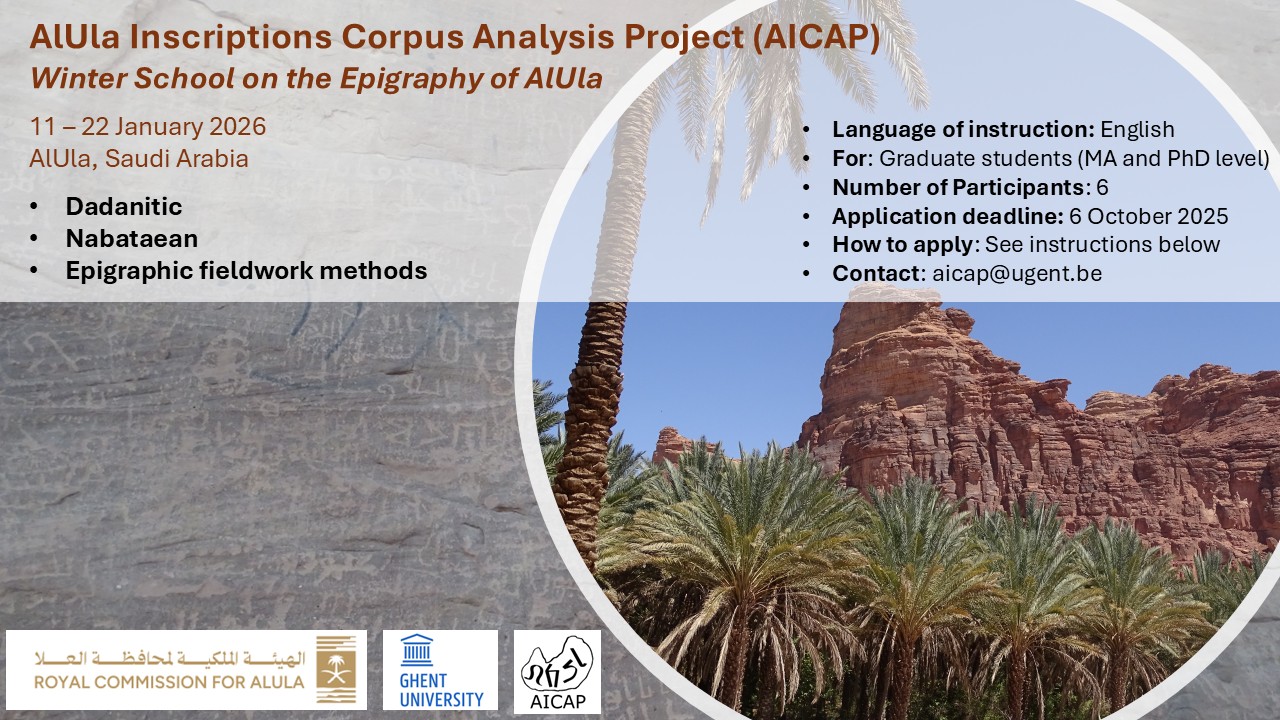
 

AICAP Winter School on the Epigraphy of AlUla

Call for Applications: AICAP Winter School on the Epigraphy of AlUla

Dates: 11 – 22 January 2026
Location: AlUla, Saudi Arabia
Language of instruction: all courses will be taught in English
Courses: Fieldwork methods; Dadanitic; Nabataean
Instructors: Jérôme Norris (epigraphic fieldwork methods); Fokelien Kootstra-Ford (Dadanitic); Benjamin Suchard (Nabataean)

The AICAP project (AlUla Inscriptions Corpus Analysis Project) is pleased to announce a two-week Winter School designed for graduate-level students with an interest in epigraphy, ancient languages, digital humanities, archaeology, and the cultural heritage of Northwest Arabia.
The AlUla region is home to a wealth of documentary heritage written on stone throughout many centuries. Between 2018 and 2020, the Royal Commission for AlUla’s IDIHA project documented over 20.000 inscriptions in the region, written in many different scripts, ranging from the pre-Islamic era, including various types of Aramaic scripts, Ancient South Arabian, and variants of the Ancient North Arabian scripts, up to Early Islamic Arabic and Modern Arabic inscriptions. AICAP is dedicated to analyzing the epigraphic material that they collected and to build an online searchable database to facilitate research on AlUla’s epigraphic heritage.
AICAP is hosting this winter school to offer hands on training to work with AlUla’s epigraphic material. Over the course of two weeks, students will be introduced to Dadanitic, Nabataean and epigraphic fieldwork methods. This unique practical approach will allow students to immediately put the skills they are learning into practice to obtain experience with all aspects of epigraphic work, from collecting material in the field, to processing the GPS data and qualitative notes they took in the field, to reading inscriptions and writing up an edition of a short inscription.
Program and logistics:
The course will consist of two weeks (ten days, Sunday to Thursday) of full-time classes, with a weekend in between. The courses will be organized into three blocks of at least two hours each day, with the possible addition of two extra hours for field trips (8–10 a.m./10 a.m.–12 p.m., 2–6 p.m.).
Students will have to arrange their own travel to AlUla. If you are travelling from outside Saudi Arabia, please be aware that you will need a visa to enter the country. Unfortunately, AICAP cannot offer funding for this.
In AlUla, we will make sure that there will be transportation from the airport to your accommodation.
In AlUla, we can offer you housing and meals. At the accommodation, both men and women will stay in the same house. To ensure privacy, men’s and women’s bedrooms and bathrooms will be in different areas of the accommodation.
Max number of participants: 6
Who should apply: Graduate students (MA and PhD level) in relevant fields such as archaeology, ancient history, epigraphy, Semitic studies, digital humanities, and GIS. Knowledge of at least one Semitic language (such as Arabic) is a requirement. A background in the history of the region, philology, archaeology or epigraphy is helpful but not required.
How to apply: Please send an email with:
– Your CV
– A letter of motivation
To Areen Sweetat: aicap@ugent.be
Application deadline: 6 October 2025
Please contact Areen Sweetat with any questions about the application: aicap@ugent.be
For more information about AICAP, please visit:
https://research.flw.ugent.be/en/projects/aicap-alula-inscriptions-corpus-analysis-project.
Find us on social media:
• on X: @AicapUgent
• on Instagram: @aicap2025

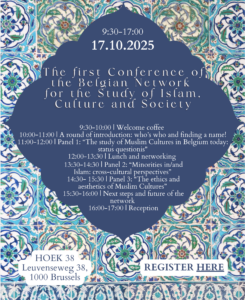
First conference of the Belgian Network for the Study of Islam, Culture and Society (17/10/25)

First conference of the Belgian Network for the Study of Islam, Culture and Society

Academics from the different Belgian universities have gathered to set up a Belgian network for the study of Islam, Culture and Society.
The launch of this network will occur during an inaugural network day on October 17th 2025 from 9.30 – 17.00.

This is a great opportunity to meet and connect with others who are studying Islam, Muslim culture/society, Muslims as minorities, etc. from theological or social-scientific disciplinary angles.

Registration is free but mandatory and preferably by October 6th:

Venue: FWO, Auditurium, Hoek 38, Leuvenseweg 38, 1000 Brussels


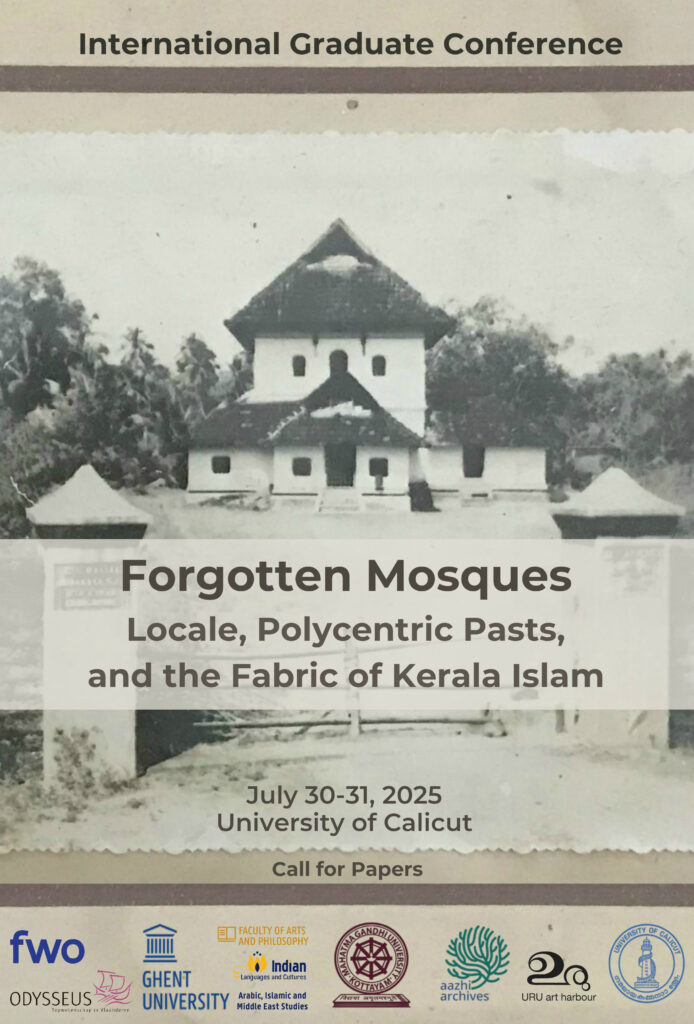
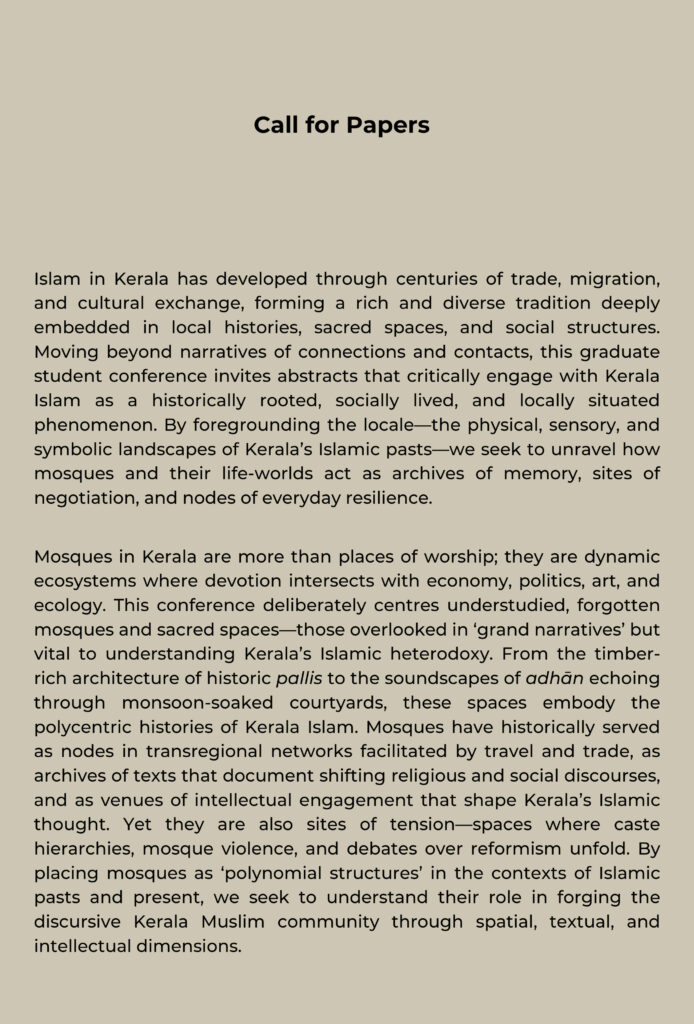
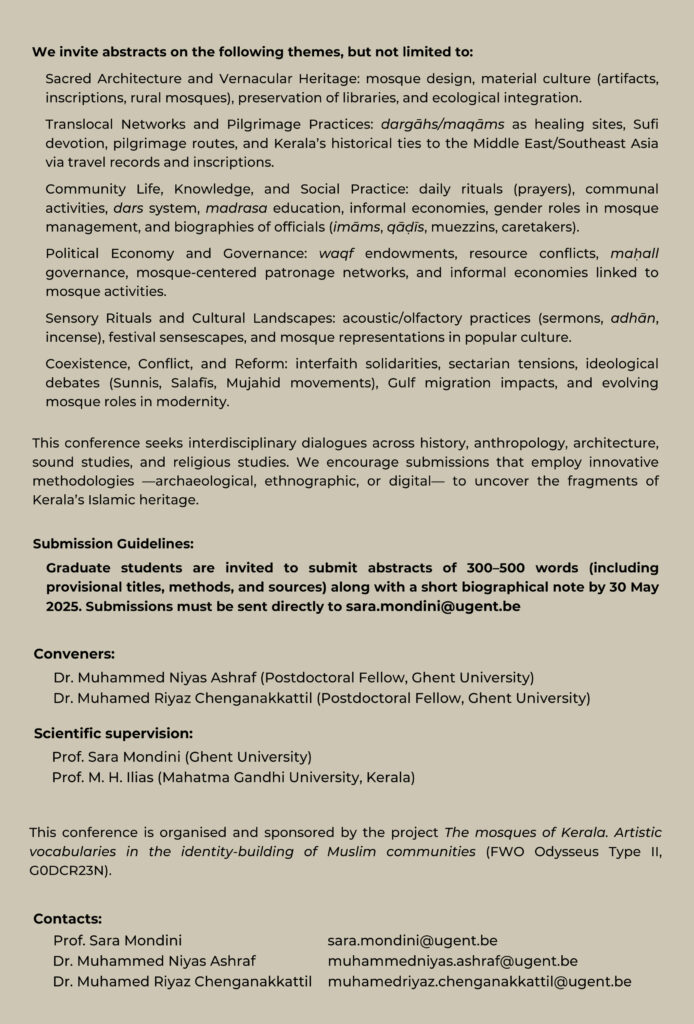
International Graduate Conference: Forgotten Mosques

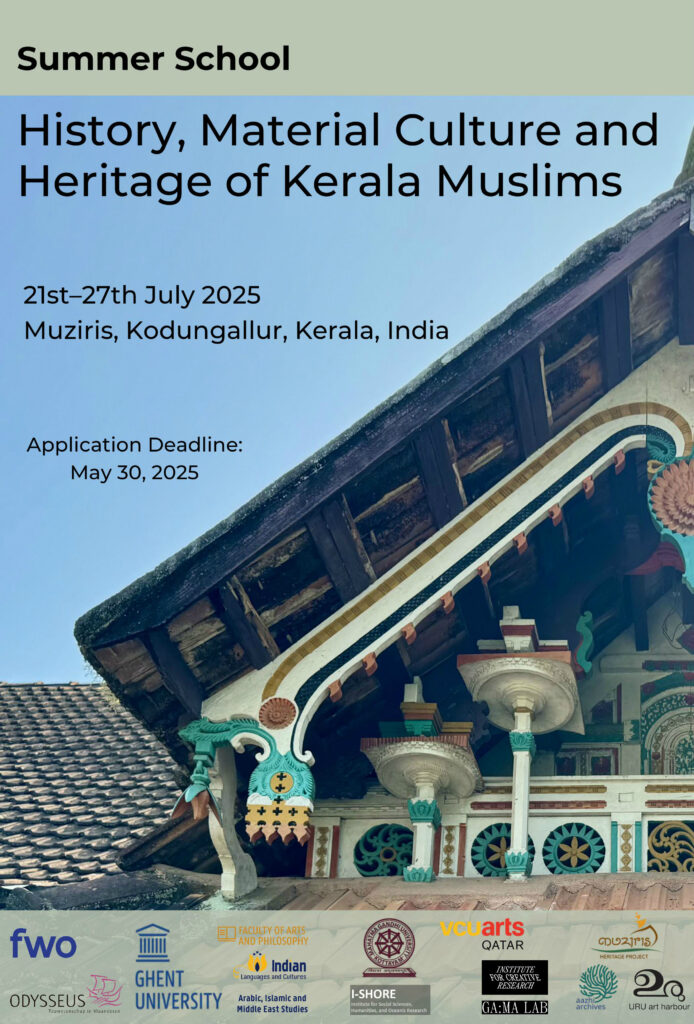
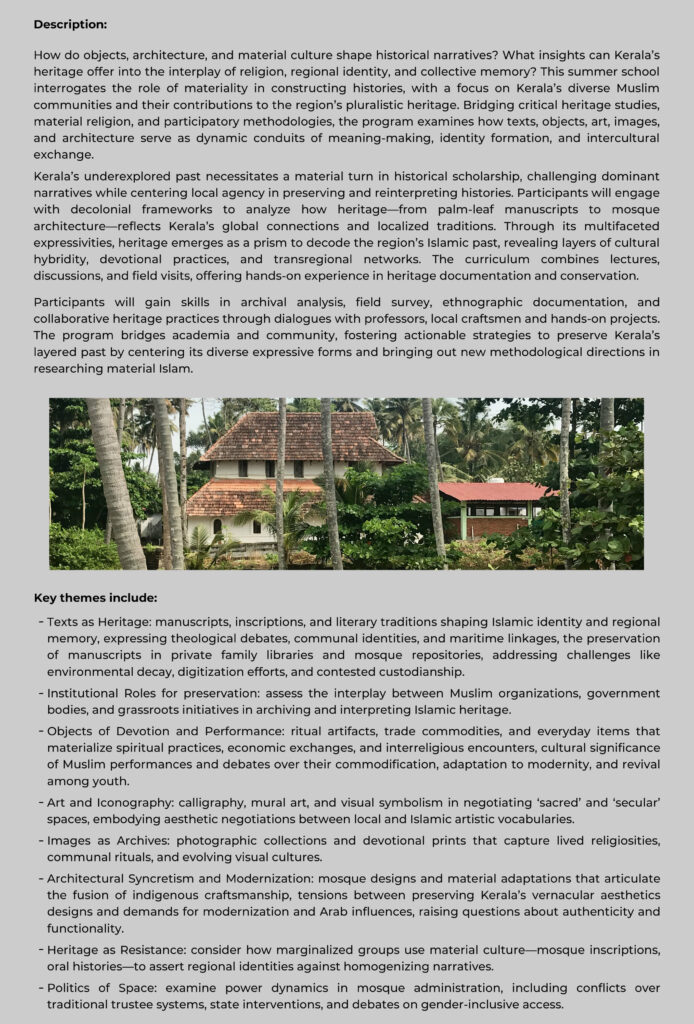
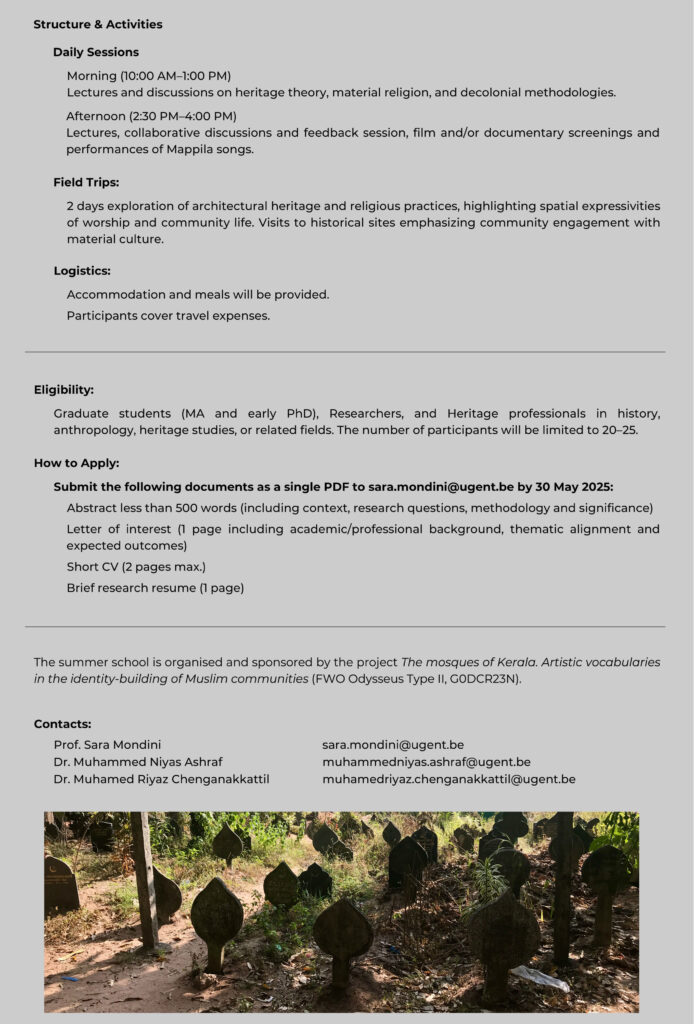
This conference seeks interdisciplinary dialogues across history, anthropology, architecture, sound studies, and religieus studies. We encourage submissions that employ innovative methodologies – archaeological, ethnographic, or digital – to uncover the fragments of Kerala’s Islamic heritage.

Internationalization@home Migrant Labour in Globalized Contexts (31/03/2025)

In the framework of ‘Internationalisation At Home’, the Department of Languages and Cultures is, on Monday 31 March 2025, organising the event ‘Migrant Labour in Globalised Contexts’.

Migrant labour is a phenomenon that not only characterizes our era of neoliberal globalization, but that has been a socio-economic and political factor and a ‘lived experience’ throughout human history.

In this ‘Internationalisation At Home’ event, a keynote lecture by Prof. dr. Sabine Damir-Geilsdorf (Universität Köln), a specialist in the domain of migration and forced migration, will introduce the participants to the issue of ‘migrant labour’ in historical and contemporary contexts, focusing on social, economic, and political aspects of migration. This keynote lecture will be followed by four workshops. The day will be concluded with a debate, moderated by Mr. Jeroen Zuallaert (Knack).


Programme:

09:00-10:00: Keynote by Sabine Damir-Geilsdorf (Universität Köln): ‘Forms of bonded migrant labour: historical and contemporary aspects’

10:00-10:15: break

10:15-11:15: workshop 1: ‘Ottoman Slavery and the Emergence of a Global Moral Order’ (Christopher Markiewicz, Miglena Dikova-Milanova; invited guest: Ceyda Karamürsel (SOAS))

11:15-12:15: workshop 2: ‘Slavery and Colonialism in the Indian Ocean World’ (Koen Bostoen; invited guest: Martin Bossenbroek)

12:15-13:45: break

13:45: 14:45: workshop 3: ‘The kafala or migrant workers’ sponsorship system in the Arab Gulf States’ (Lisa Franke; invited guest: Sabine Damir-Geilsdorf (Universität Köln))

14:45-15:45: workshop 4: ‘Sexual Labour Trafficking, Sexual Slavery, and Empire in East and Southeast Asia’ (Paride Stortini; invited guest: Nine Fumi Yamamoto-Masson)

15:45-16:00: break

16:00-17:00: roundtable with the keynote speaker and the invited speakers (moderator: Jeroen Zuallaert, Knack)


Final Migrant Poster Final Migrant Programme


Iftar

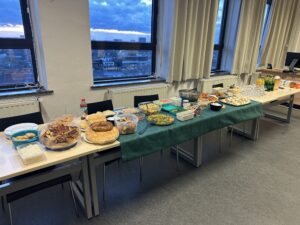
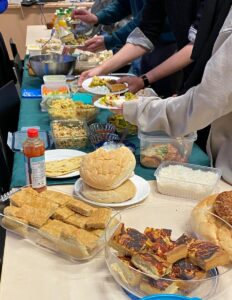
On 28 March, our section organised a warm and connecting iftar. Initiated by some students from BA1, this gathering brought together students and staff from all years for a delicious sharing meal. Everyone brought something to eat or drink. It turned out to be a very pleasant and successful evening!