Thijl Sunier: Making Islam Work: Islamic Authority Among Muslims in Western Europe (23/06/2025)

Islam, Ethics and Diversity Network – Lecture Series

Making Islam Work: Islamic Authority Among Muslims in Western Europe

Speaker: Prof. Dr. Thijl Sunier – VU University Amsterdam, discussant: Dominik Müller – University of Zürich

Thijl Sunier is professor emeritus (VU University Amsterdam) and president of the Netherlands Interuniversity School for Islamic Studies (NISIS). His work focuses on the study of migrants in Europe, Turkey and the study of Islamic religious authority.

Dominik Müller (University of Zürich) is a Lecturer on Islam in Europe at the Department of Religious Studies, University of Zurich. His research focuses on Islamic authority, the production of religious knowledge, digital Islam, and religious entrepreneurs active in the fields of health and spirituality, business, and popular culture.


Abstract of the lecture
Who speaks for Islam? Religious authority hinges on persuasiveness and addresses issues of truthfulness, authenticity, legitimacy, trust, and ethics within the realm of religious matters. While Islamic authority may seem like an inherent status for Muslim scholars, tied to their knowledge of religious sources, Sunier argues that the process of establishing Islamic authority is a continuous dynamic.

His book Making Islam Work: Islamic Authority Among Muslims in Western Europe (Brill) analyses authority as a social and relational practice that extends beyond theological proficiency and personal status, even encompassing objects, activities, and events. Moreover, he contends that the development of Islamic landscapes in Europe is intricately linked to the evolution of Islamic authority. In this talk, he will explore the diverse ways in which Islamic authority is constituted, with a specific emphasis on the role of ‘ordinary’ Muslims. Drawing on ethnographic research conducted among Muslims in Western Europe from the mid-1980s to 2020, he aims to shed light on the multifaceted dynamics of Islamic authority in this context.


Date: 23/06/2025

Time: 15:00 – 16:30 (CET)

Location: online

Contact: an.vanraemdonck@ugent.be

Simon Stjernholm: Sensory Engagements in the Study of Muslim Piety (26/05/2025)

Islam, Ethics and Diversity Network – Lecture Series

Sensory Engagements in the Study of Muslim Piety

Speaker: Simon Stjernholm, Associate Professor – University of Copenhagen , discussant: Merve R. Kayikci, postdoctoral researcher – KADOC

Simon Stjernholm is Associate Professor of the Study of Religion at the University of Copenhagen. His work is situated in the anthropology and history of Islam, with particular focus on Sufism and Muslim preaching.

Discussant Merve R. Kayikci is a postdoctoral researcher for the KADOC Documentation and Research Center on Religion, Culture and Society, Belgium.


Abstract of the lecture
How have practices and imaginaries of sensing been religiously engaged and contested by Muslims? How do contemporary Muslim practices and debates concerning religious sensing relate to historical precedents? Simon Stjernholm’s new book Sensing Islam: Engaging and Contesting the Senses in Muslim Religiosity (Bloomsbury) analyses examples dealing with contemporary Sufism and Muslim religious oratory in order to explore practices and imaginaries of sensing. Combining the research fields of Islamic Studies, anthropology of Islam, material religion and sensory studies, this book covers a range of materials, including writings by Muslim religious authorities, ethnographic material, audio recordings and videos. In this talk, he will present the general framework of the book and discuss a few examples of its analyses in detail.


Date: 26/05/2025

Time: 15:00 – 16:30 (CET)

Location: online

Contact: an.vanraemdonck@ugent.be

Ingvild Flaskerud: Notions of ‘Ethicization’ of Islam in Europe Reconsidered (28/04/2025)

Islam, Ethics and Diversity Network – Lecture Series

Notions of ‘Ethicization’ of Islam in Europe Reconsidered

Speaker: Ingvild Flaskerud, research associate – University of Oslo, discussant: Younes Saramifar, assistant professor – VU University Amsterdam

Ingvild Flaskerud is research associate at the Faculty of Theology at Oslo University. Her main research interests include contemporary Twelver Shi’ite thought and practice in both Iran and Europe.

Discussant Younes Saramifar is an anthropologist and cultural sociologist. He is currently assistant professor at the History Department, VU University Amsterdam.

Abstract of the lecture
In this online seminar, Ingvild Flaskerud (University of Oslo) reflects on the so-called ‘ethicization’ of Islam in Europe. Based on ethnographic research, she offers some perspectives on the position and formation of virtue ethics, adab, among young Twelver Shia Muslims in Norway. Representing an alternative to scholastic deliberations on normative ethics, she discusses how the youths’ critical conceptualizations of their faith takes place within the structural frameworks of customary rituals and established theological positions while being shaped in response to current public debates on Islam and face-to-face encounters with Muslims and non-Muslims. This ethnographic approach to ethical formation also highlights some methodological issues, namely the significance of combining textual sources, material culture, embodied practices and interactions, and aesthetic experiences.


Date: 28/04/2025

Time: 15:00 – 16:30 (CET)

Location: online

Contact: an.vanraemdonck@ugent.be

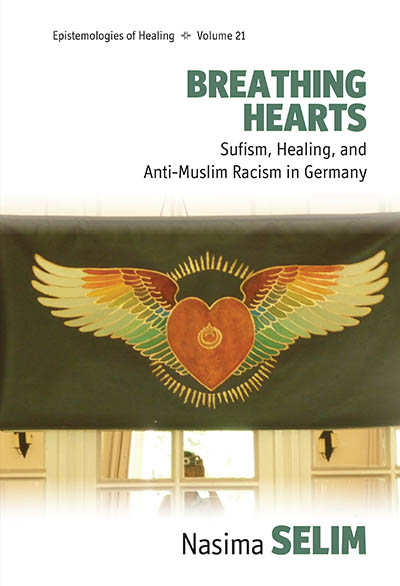
Nasima Selim: Breathing Hearts in Suffocating Times: Sufi Healing Practices and anti-Muslim racism in Germany (31/03/2025)

Islam, Ethics and Diversity Network – Lecture Series

Breathing Hearts in Suffocating Times: Sufi Healing Practices and Anti-Muslim Racism in Germany

Nasima Selim, Postdoctoral Research Associate of Anthropology – University of Bayreuth.

Nasima’s work intersects medical anthropology, global health, public anthropology, and anthropology of Islam across Western Europe and South Asia. She is a breathworker, educator, researcher, and writer.


Abstract of the lecture:

In this online seminar, Nasima Selim will discuss her book Breathing Hearts in Suffocating Times. Sufism is known as the mystical dimension of Islam. Breathing Hearts explores this definition to find out what it means to ‘breathe well’ along the Sufi path in the context of anti-Muslim racism. Breathing Hearts in Suffocating Times is the first book-length ethnographic account of Sufi practices and politics in Berlin and describes how Sufi practices are mobilized in healing secular and religious suffering. The book tracks the Desire Lines of multi-ethnic immigrants of color, and white German interlocutors to show how Sufi practices complicate the post secular imagination of healing in Germany.


Date: 31/03/2025

Time: 15:00 – 16:30 (CET)

Location: online

Contact: an.vanraemdonck@ugent.be

Johan Rasanayagam: “We need to trust in God”: Living with Hope in Morocco and the Problem of Agency in a Secular Anthropology (24/02/2025)

Islam, Ethics, and Diversity – Lecture Series

“We need to trust in God”: Living with Hope in Morocco and the Problem of Agency in a Secular Anthropology

Speaker: Dr. Johan Rasanayagam – University of Aberdeen, discussant: Laura Menin – University of Sussex

Johan Rasanayagam has conducted extensive fieldwork in Uzbekistan, Central Asia on themes of Islam, citizenship, and moral selfhood. More recently, he has conducted research on Islam, illness and healing in Morocco. His current research focuses on developing an engagement between anthropology and Islamic traditions of thought.


Abstract of the lecture
In this online seminar, Johan Rasanayagam reflects on the theme of hope through conversations with Muslims in Morocco on the need to place trust in God and through reading of parts of the Islamic scholarly tradition, putting this in dialogue with anthropological discussions on hope. He sees this effort as a post-secular anthropology that seeks to recognise modes of perceiving, knowing, and being expressed within the Islamic tradition. Anthropological discussions on hope have been greatly influenced by the philosopher Ernst Bloch’s The Principle of Hope. They predominantly frame hope as an anticipatory reaching forward in the present towards the realisation of a desired future. Bloch infuses hope with an active, agentive quality, and this is what makes it intelligible as a universal theme for anthropological theorising. Conversations in Morocco decentre the emphasis on anticipatory, future orientated hope. Critically, the Islamic tradition grounds living with hope in an agency external to and greater than the human. This makes it unintelligible to a secular anthropology, except as an expression of a specifically Islamic worldview. To recognise this Islamic conception of hope is to open ourselves to the suggestion that human being is itself made possible by reliance on something beyond human agency.


Date: 24/02/2025

Time: 15:00 – 16:30 (CET)

Location: online

Contact: an.vanraemdonck@ugent.be

Amani Hassani: Navigating Colour-Blind Societies: A Comparative Ethnography of Muslim Urban Life in Copenhagen and Montreal (27/01/2025)

Islam, Ethics and Diversity Network – Lecture Series

Navigating Colour-Blind Societies: A Comparative Ethnography of Muslim Urban Life in Copenhagen and Montreal

Dr. Amani Hassani – Brunel University

Amani Hassani is an urban ethnographer working at the intersection of sociology, anthropology, and human geography. Her research explores the connection between racialisation and spatialisation, focusing on Muslim populations in the Global North.


Abstract of the lecture
In this online lecture, Amani Hassani will discuss her book Navigating Colour-Blind Societies, a comparative ethnography of racialisation, class, and gender in the lives of young Muslims coming of age in societies where race is deemed insignificant.

The book offers insights into the urban lives of young middle-class Muslims in Copenhagen and Montreal. Based on their narratives, the book examines racialisation as (1) a social process that is classed and gendered and (2) a spatial process that is social and temporal. Denmark and Quebec have seen an increasing thrust of nationalist politics in recent years, which position their Muslim citizens as the quintessential “Other.” The book contributes to our understanding of how Muslims are racialised and how they navigate this process of racialisation in social and urban life. The interaction between movement and life stories provides a unique vantage point in bringing the city to life from the perspective of these young adults.


Date: 27/01/2025

Time: 15:00 – 16:30 (CET)

Location: online

Contact: an.vanraemdonck@ugent.be

Francesco Piraino: Exploring Sufi Politics in Europe: Civic Engagement, Metapolitics, and Apolitical Millenarism (16/12/2024)

Islam, Ethics and Diversity Network – Lecture series

Exploring Sufi Politics in Europe: Civic Engagement, Metapolitics, and Apolitical Millenarism

Francesco Piraino, PhD – University of Bologna

Abstract of the lecture
Sufism, the spiritual, mystical, and esoteric dimension of Islam, is experiencing a renewal in the 21st century. Charismatic Sufi masters have been able to revitalize their language, attracting new disciples and going beyond their cultural-geographic framework.

In this seminar, Francesco Piraino will present his new book Sufism in Europe, Islam, Esotericism, and the New Age (Edinburgh University Press, 2024). This book describes the development of Sufism in Western Europe, particularly in France and Italy, through extended empirical research based on participant observation in four Sufi orders. The author illustrates the different forms of hybridization between the Islamic-Sufi tradition and Western esoteric discourses, in particular the Guénonian-Traditionalist and the New Age discourse.

In this seminar, Piraino will discuss his methodologies, proposing a socio-anthropology of mysticism and Sufism, and Sufi politics, describing three Sufi political approaches: civic engagement, metapolitics, and apolitical millenarism.


Date: 16/12/2024

Time: 16:00 – 17h30 (CET)

Location: Online

Contact: an.vanraemdonck@ugent.be