AICAP Winter School on the Epigraphy of AlUla

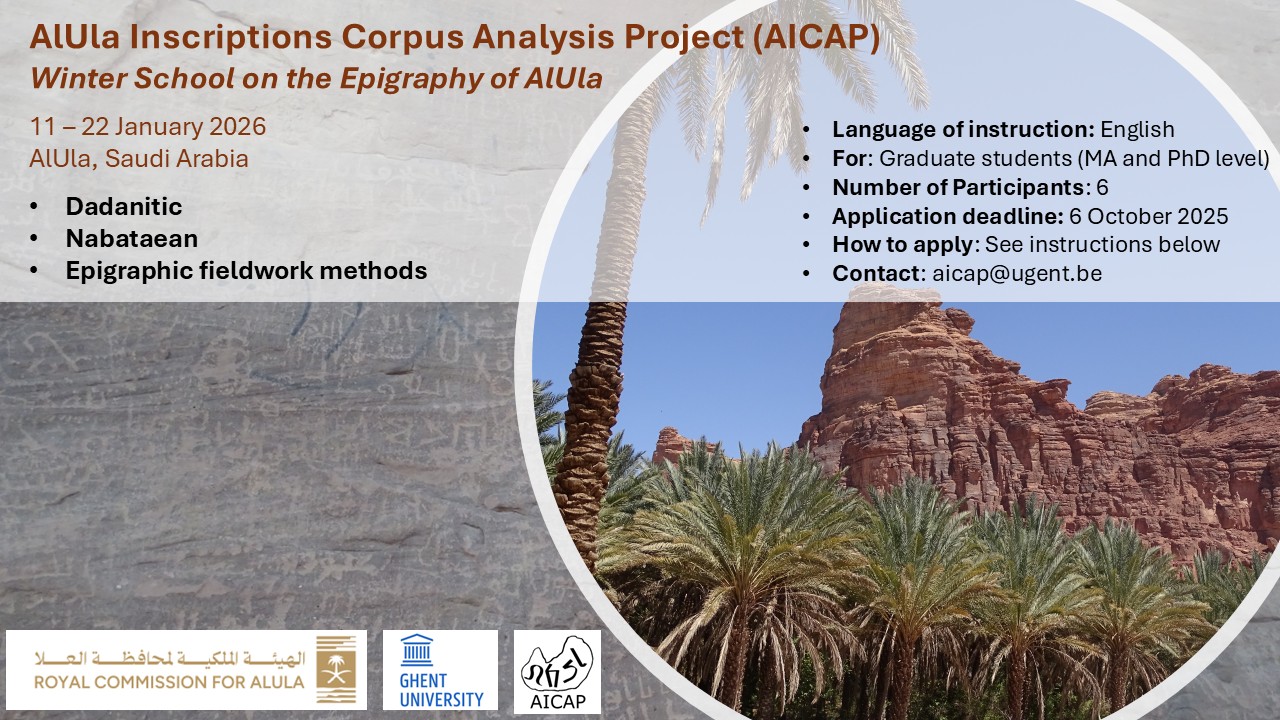
Call for Applications: AICAP Winter School on the Epigraphy of AlUla

Dates: 11 – 22 January 2026
Location: AlUla, Saudi Arabia
Language of instruction: all courses will be taught in English
Courses: Fieldwork methods; Dadanitic; Nabataean
Instructors: Jérôme Norris (epigraphic fieldwork methods); Fokelien Kootstra-Ford (Dadanitic); Benjamin Suchard (Nabataean)

The AICAP project (AlUla Inscriptions Corpus Analysis Project) is pleased to announce a two-week Winter School designed for graduate-level students with an interest in epigraphy, ancient languages, digital humanities, archaeology, and the cultural heritage of Northwest Arabia.
The AlUla region is home to a wealth of documentary heritage written on stone throughout many centuries. Between 2018 and 2020, the Royal Commission for AlUla’s IDIHA project documented over 20.000 inscriptions in the region, written in many different scripts, ranging from the pre-Islamic era, including various types of Aramaic scripts, Ancient South Arabian, and variants of the Ancient North Arabian scripts, up to Early Islamic Arabic and Modern Arabic inscriptions. AICAP is dedicated to analyzing the epigraphic material that they collected and to build an online searchable database to facilitate research on AlUla’s epigraphic heritage.
AICAP is hosting this winter school to offer hands on training to work with AlUla’s epigraphic material. Over the course of two weeks, students will be introduced to Dadanitic, Nabataean and epigraphic fieldwork methods. This unique practical approach will allow students to immediately put the skills they are learning into practice to obtain experience with all aspects of epigraphic work, from collecting material in the field, to processing the GPS data and qualitative notes they took in the field, to reading inscriptions and writing up an edition of a short inscription.
Program and logistics:
The course will consist of two weeks (ten days, Sunday to Thursday) of full-time classes, with a weekend in between. The courses will be organized into three blocks of at least two hours each day, with the possible addition of two extra hours for field trips (8–10 a.m./10 a.m.–12 p.m., 2–6 p.m.).
Students will have to arrange their own travel to AlUla. If you are travelling from outside Saudi Arabia, please be aware that you will need a visa to enter the country. Unfortunately, AICAP cannot offer funding for this.
In AlUla, we will make sure that there will be transportation from the airport to your accommodation.
In AlUla, we can offer you housing and meals. At the accommodation, both men and women will stay in the same house. To ensure privacy, men’s and women’s bedrooms and bathrooms will be in different areas of the accommodation.
Max number of participants: 6
Who should apply: Graduate students (MA and PhD level) in relevant fields such as archaeology, ancient history, epigraphy, Semitic studies, digital humanities, and GIS. Knowledge of at least one Semitic language (such as Arabic) is a requirement. A background in the history of the region, philology, archaeology or epigraphy is helpful but not required.
How to apply: Please send an email with:
– Your CV
– A letter of motivation
To Areen Sweetat: aicap@ugent.be
Application deadline: 6 October 2025
Please contact Areen Sweetat with any questions about the application: aicap@ugent.be
For more information about AICAP, please visit:
https://research.flw.ugent.be/en/projects/aicap-alula-inscriptions-corpus-analysis-project.
Find us on social media:
• on X: @AicapUgent
• on Instagram: @aicap2025
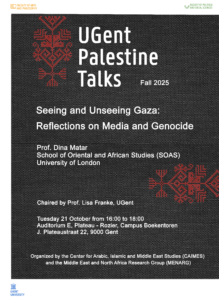
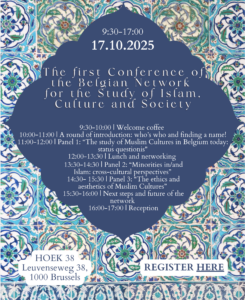
Selma Dabbagh, Mahmoud Nabil Ahmed and Frank Barat: A conversation about “A State of Passion” (Palestine Talks Autumn 2025 – 3/11)

Palestine Talks Autumn 2025

A State of Passion

Carol Mansour and Muna Khalidi

Screening of documentary “A State of Passion” in the framework of the of Palestine Cinema Days organised by the Filmlab Palestine in collaboration with UGent Palestine Talks.

a feature-length documentary by Carol Mansour and Muna Khalidi.

A State of Passion is a feature-length documentary by Carol Mansour and Muna Khalidi. After 43 harrowing days working under relentless bombardment in Gaza’s Al Shifa and Al Ahli hospitals, British-Palestinian reconstructive surgeon Dr. Ghassan Abu Sittah emerged as a symbol of Palestinian resistance.

The screening will be accompanied by a conversation with writer and lawyer Selma Dabbagh, film director Mahmoud Nabil Ahmed and producer Frank Barat.

Selma Dabbagh is a British-Palestinian writer and lawyer. Her debut novel Out of It (Bloomsbury, 2011) set between Gaza, London and the Gulf was listed as a best book on Israel/Palestine by the Guardian in 2024. Her fiction includes short stories, radio plays for BBC and WDR in Germany as well as productions for stage (Asmahan, Sadlers Wells, 2025) and screen (collaboration on the script of Palestine 1936). She is the editor of We Wrote In Symbols; Love and Lust by Arab Women Writers (Saqi, 2021). Since October 2023 she has been writing regular blogs for the London Review of Books and has also written for PORT, INQUE, The Guardian and The Observer. A new short story Katamon will be coming published in the collection Palestine -1 (Comma Press, 2025). Selma holds an LLM in Law from SOAS and a PhD from Goldsmiths, both University of London.

Mahmoud Nabil Ahmed is a Palestinian filmmaker from Gaza, now based in Belgium. He studied directing at ISAMM and film editing at ESAC in Tunisia, where he began shaping a visual language built on stillness, memory, and the quiet details of everyday life. His short films The War Inside Us and Matchstick explore fragile moments of endurance and connection. In 2024, he directed Gazan Tales, a documentary that lingers on everyday life in Gaza — gestures, sounds, and routines that reveal how people keep living, even when everything else falls apart.

Frank Barat is a film producer, journalist and author. He has worked on books with Noam Chomsky, Angela Davis, Ilan Pappé, Ken Loach, Vijay Prashad and Marc Lamont Hill. He is executive producer on Annemarie Jacir’s “Palestine 36” and Kaouther Ben Hania “The Voice of Hind Rajab”. He is part of the production team of the Together for Palestine concerts, including in Brussels, Paris and London.

Mohanad Yaqubi is a Palestinian filmmaker, now resident researcher at School of Arts (KASK) in Gent, Belgium. He is co-founder of the Ramallah-based production company Idioms Film, the research and curatorial collective Subversive Films, and a founding member of the Palestine Film Institute. His first feature film, Off Frame AKA Revolution Until Victory (2016), premiered at major international festivals.


Date: 03/11/2025

Time: 08.30pm

Venue: KASK Cinema – School of Arts Ghent, Louis Pasteurlaan 2, 9000 Gent

Free entrance – Reservation required


This event is co-organised by Palestine Talks, CAIMES, MENARG, KASK Cinema, and Palestine Cinema Days.


Sara Mondini: Reframing Islamic Architecture: The Malabar Coast Case and the Rethinking of Pedagogy and Disciplinary Perspectives (Research Seminar 2025 – 30/10)

Middle East Studies Research Seminar Series

Reframing Islamic Architecture: The Malabar Coast Case and the Rethinking of Pedagogy and Disciplinary Perspectives

with Prof. Dr. Sara Mondini (Ghent University)


Date: 30/10/2025 (postponed due to our participation in the national academics and students strike for Palestine)

Time: 4pm to 6pm

Venue: room 6.60, Faculty of Arts, Blandijn, Blandijnberg 2, 9000 Gent

Contact: middleeast@ugent.be

First conference of the Belgian Network for the Study of Islam, Culture and Society (17/10/25)

First conference of the Belgian Network for the Study of Islam, Culture and Society

Academics from the different Belgian universities have gathered to set up a Belgian network for the study of Islam, Culture and Society.
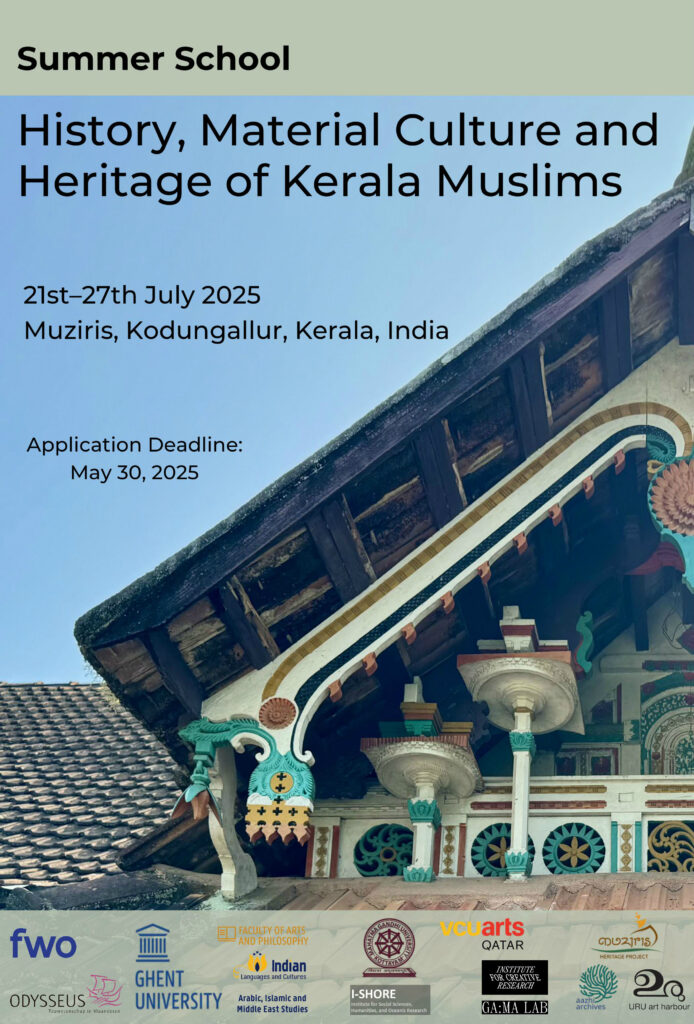
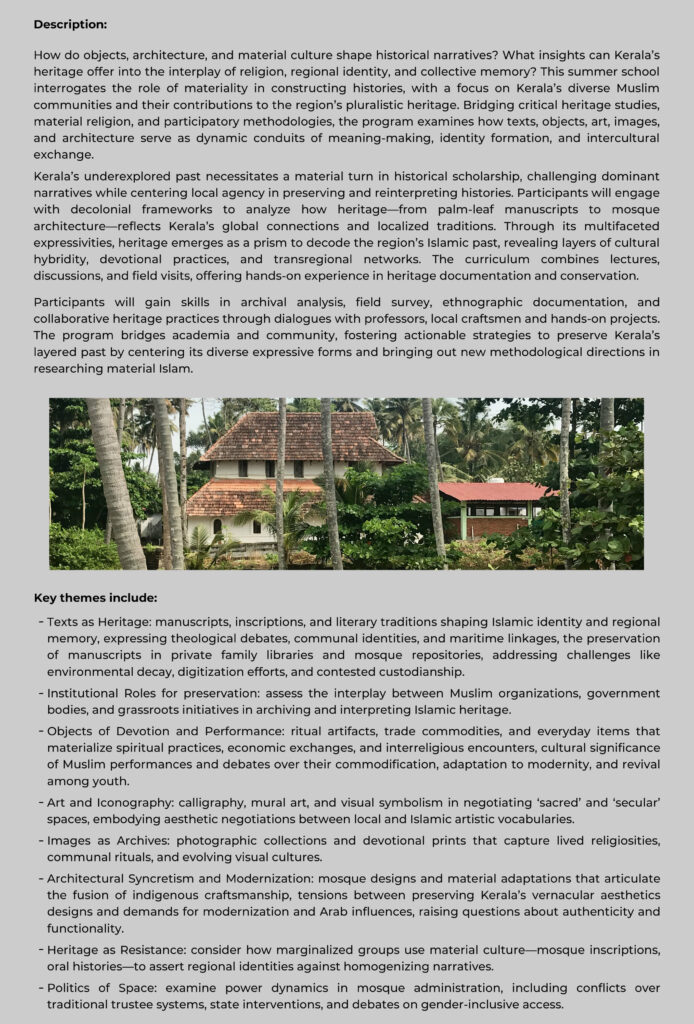
The launch of this network will occur during an inaugural network day on October 17th 2025 from 9.30 – 17.00.

This is a great opportunity to meet and connect with others who are studying Islam, Muslim culture/society, Muslims as minorities, etc. from theological or social-scientific disciplinary angles.

Registration is free but mandatory and preferably by October 6th:

Venue: FWO, Auditurium, Hoek 38, Leuvenseweg 38, 1000 Brussels


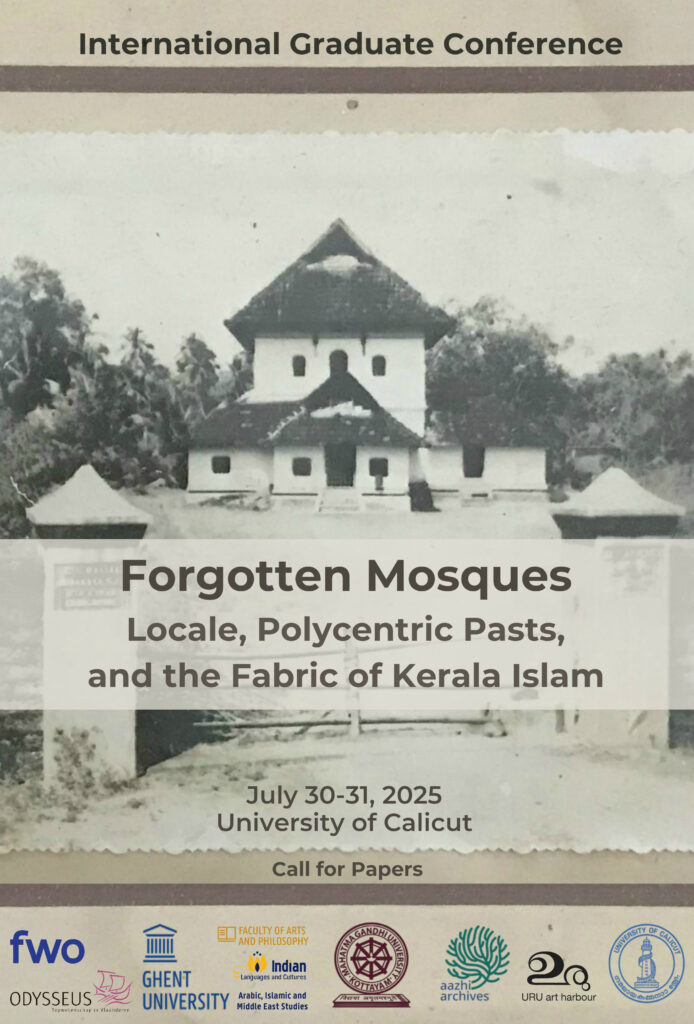
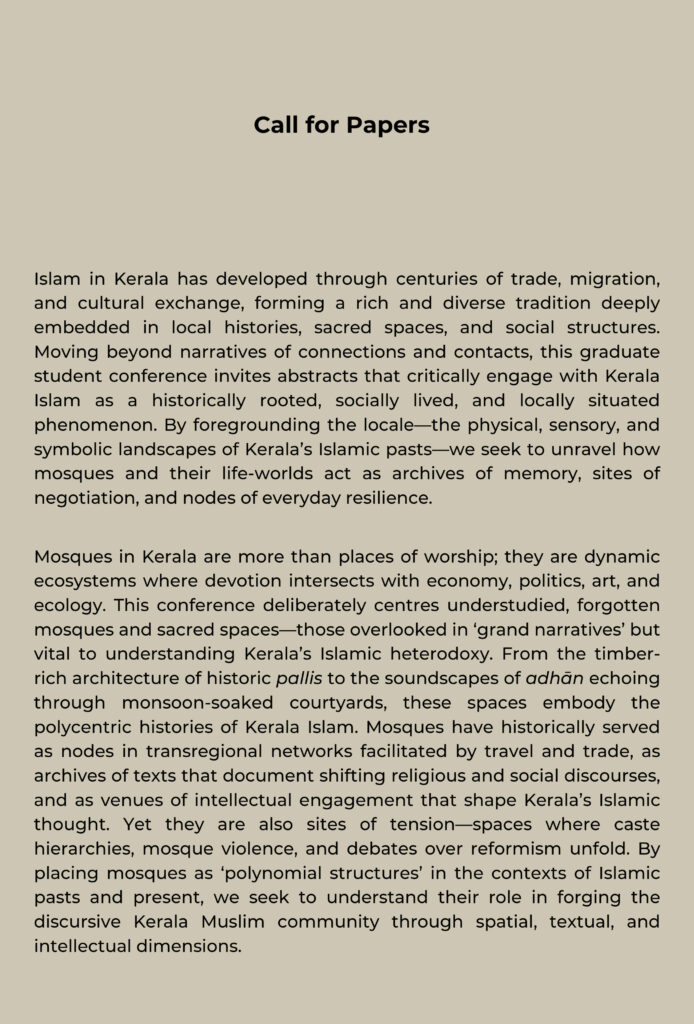
International Graduate Conference: Forgotten Mosques

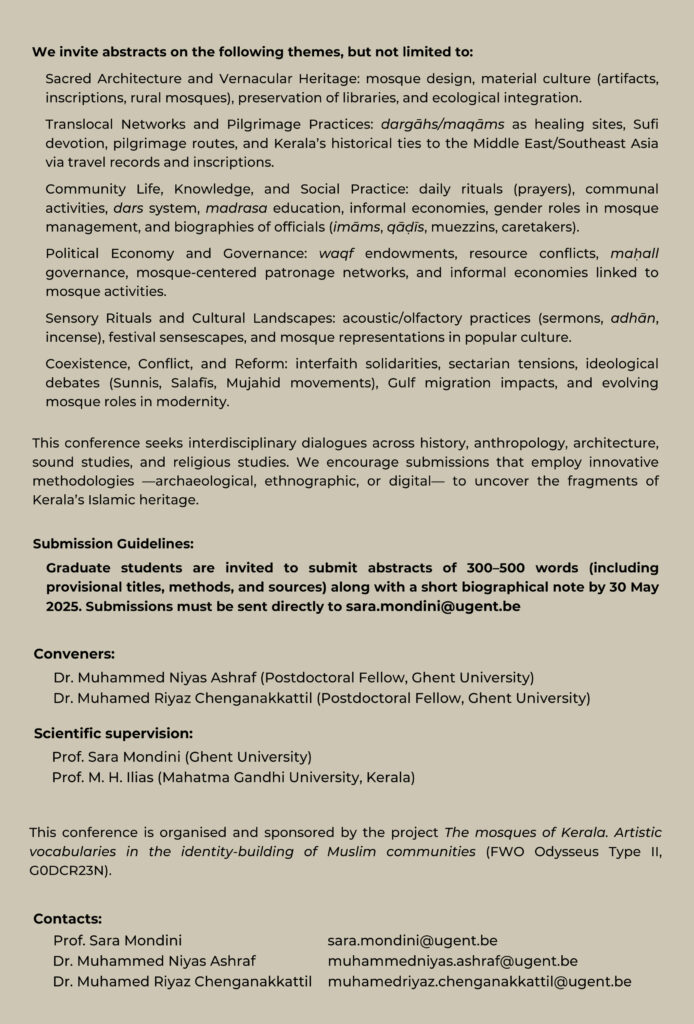
This conference seeks interdisciplinary dialogues across history, anthropology, architecture, sound studies, and religieus studies. We encourage submissions that employ innovative methodologies – archaeological, ethnographic, or digital – to uncover the fragments of Kerala’s Islamic heritage.